Vissannapeta, NTR District
It began with the neighbours asking for one more jar
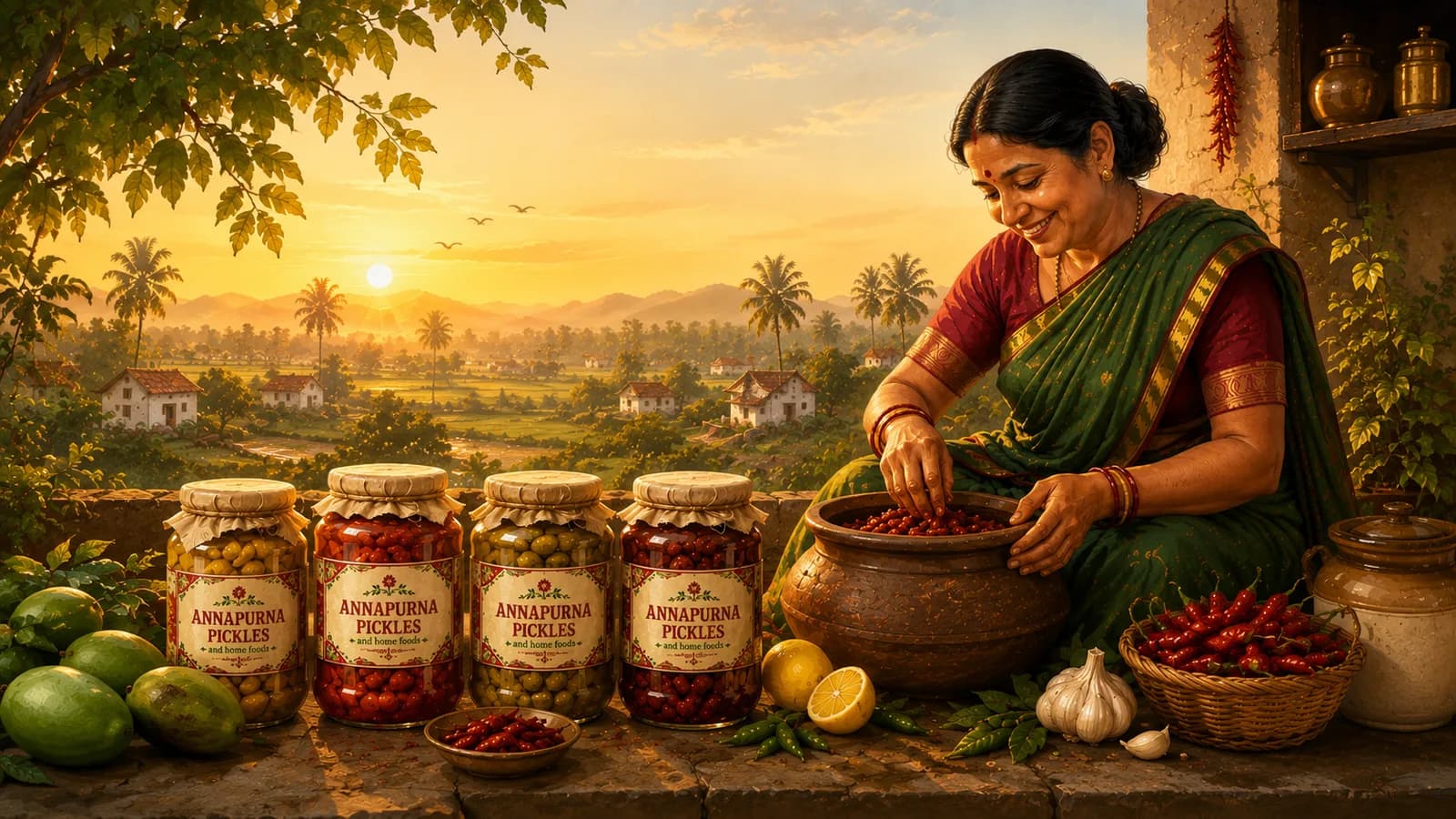
Nadella Indira has been making pickle in the same kitchen on Nuziveedu Road for thirty years. What began as one season's avakaya for the household is now nineteen items that go out across India and to five countries — but it is still one kitchen, and still the same hands cutting the mango.
How it went
Thirty years, in order
- 1995
The first season
A batch of avakaya made for the house, and enough left over for the two families next door. Nothing was sold — it was given away, and then it was asked for again.
- The generation before
Started by her mother-in-law
The recipes did not begin with Indira. Her atha built the reputation first, cooking to order for government departments and private buyers long before any of it had a name on a label. Indira learned in that kitchen, and later took it on.
- 2003
Beyond the street
Orders started coming from Vijayawada and Nuzvid by word of mouth. The podis were added because customers kept asking what to eat on the days there was no curry.
- 2011
The non-veg range
Chicken and prawns pickle, made in a separate area with separate vessels from the start. That separation has never been relaxed.
- 2018
The first parcel abroad
Six jars to a nephew in New Jersey. It arrived intact, which taught us more about packing than anything before it. Overseas orders have run steadily since.
- 2026
Registered and online
FSSAI registration 20126131000094 and a proper catalogue, so anyone can order without having to know somebody who knows us.
Beyond the jar
What is behind the label
The mangoes come from our own land
The family owns mango farms in Vissannapeta — the same soil the fruit for the avakaya is cut from. What we do not use goes on to the Nuzvid market, which is where most of the district's mangoes end up. So the fruit in the jar has not been bought at a mandi and trucked in; it comes off land the family works, and the cutting starts the day it is picked.
Government orders, and a stall in New Delhi
The kitchen has supplied government orders for years, and has held pickle stalls in New Delhi. Alongside that there is a steady run of private and bulk orders, and long-standing tie-ups that have outlasted most of the people who arranged them. None of it changed the recipe — the same batch that goes to a department order is the batch that goes into a jar for one household.
Made by women from Vissannapeta
Indira works with local women from the village — the cutting, grinding, filling and tying is all done by hand, by people who live within walking distance of the kitchen. When a bulk order comes in it is more hands, not a machine.
Recognitions and certifications
The kitchen has collected a number of certifications and recognitions across those years, and is registered with the FSSAI under licence 20126131000094.
How a jar happens
Five things, in the same order, since 1995ఎలా తయారవుతుంది
None of it is quick, and none of it has changed. This is the whole process — there is no sixth step we are not telling you about.
 1
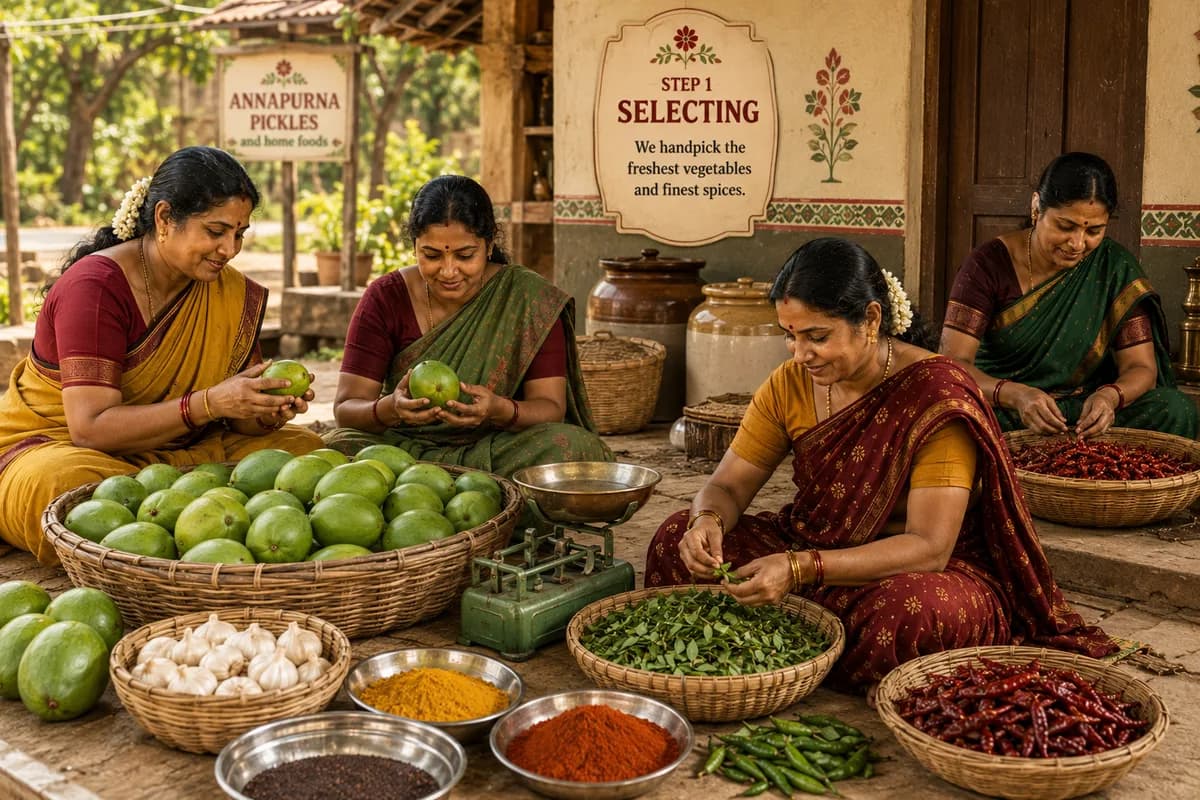
1The mangoes are chosen, not ordered
Nuzvid, eighteen kilometres away, before the first rain. Sour, firm, and cut the same day — a mango that has started to turn will not hold for a year.
 2
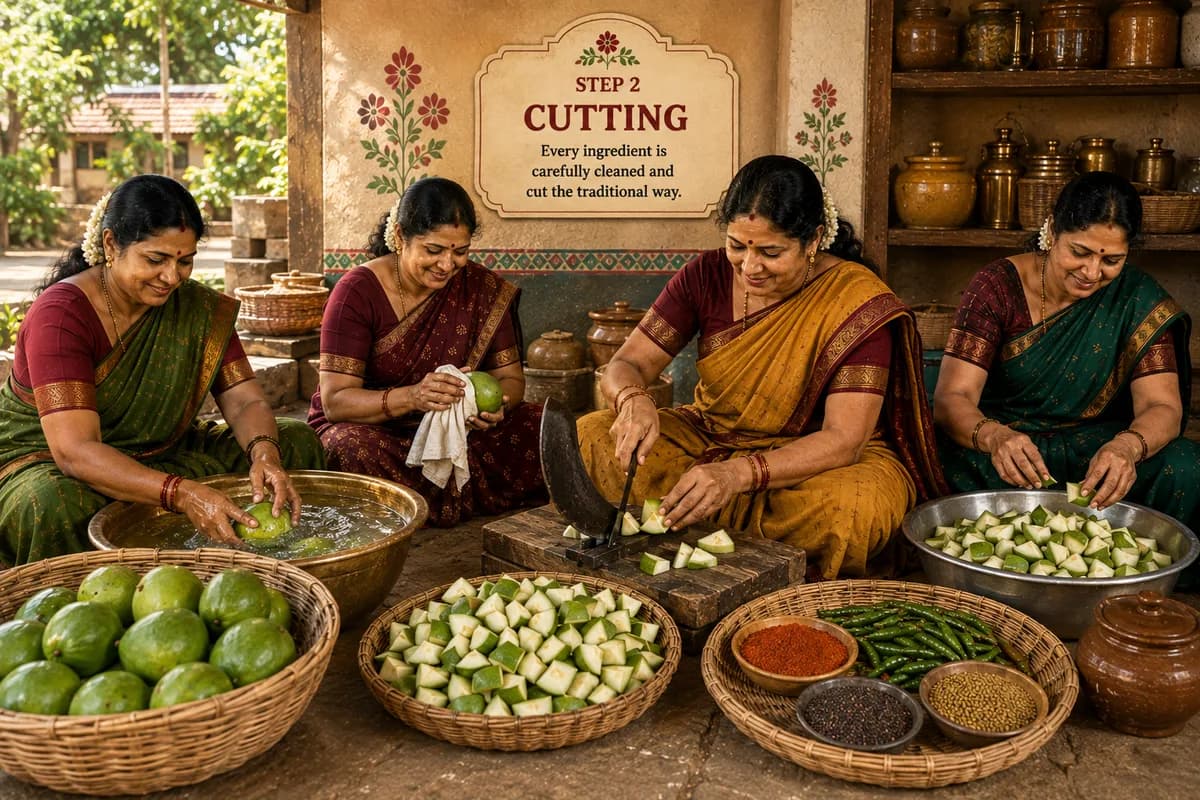
2Cut by hand, on the floor, with a curved blade
A machine cuts a clean cube and crushes the cell walls doing it. The curved blade tears along the grain, which is what lets the masala get inside the piece.
 3
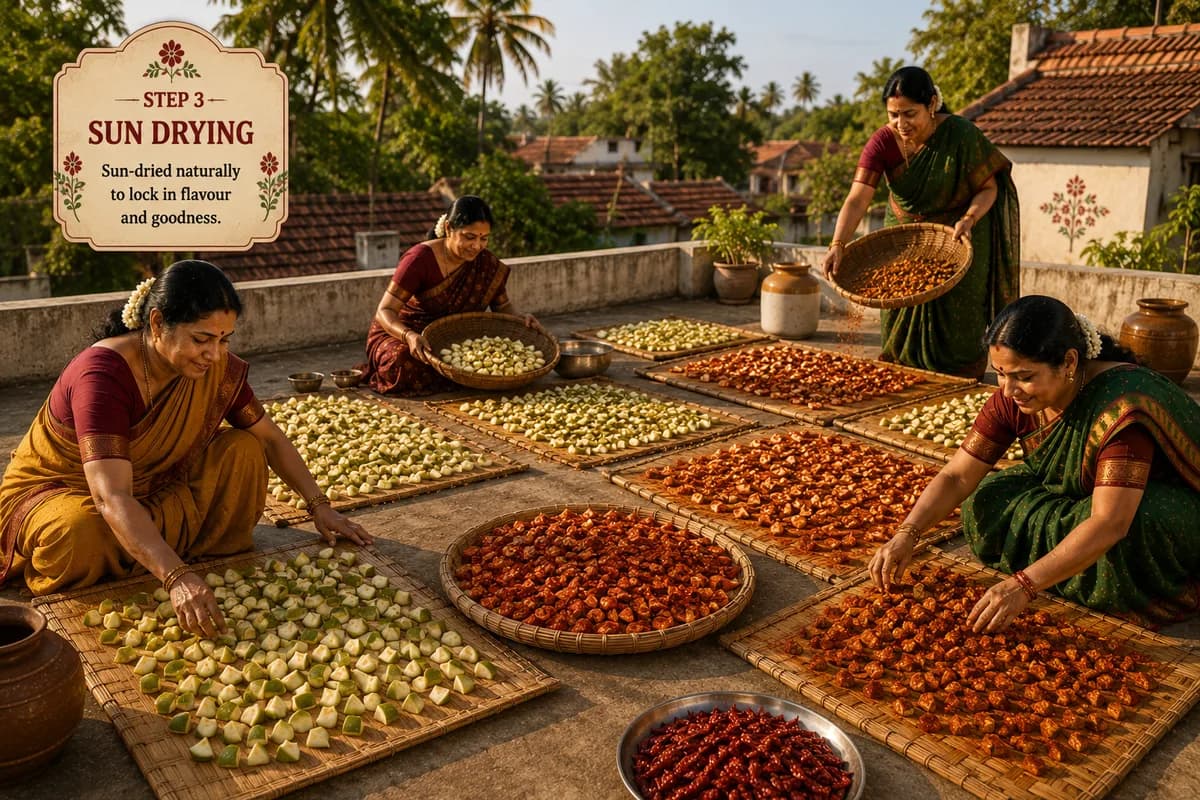
3The chilli dries in the sun, not an oven
Guntur chilli, spread on a mat in the courtyard and turned through the morning. Then stone-ground — never milled fine, because fine powder goes bitter in oil.
 4
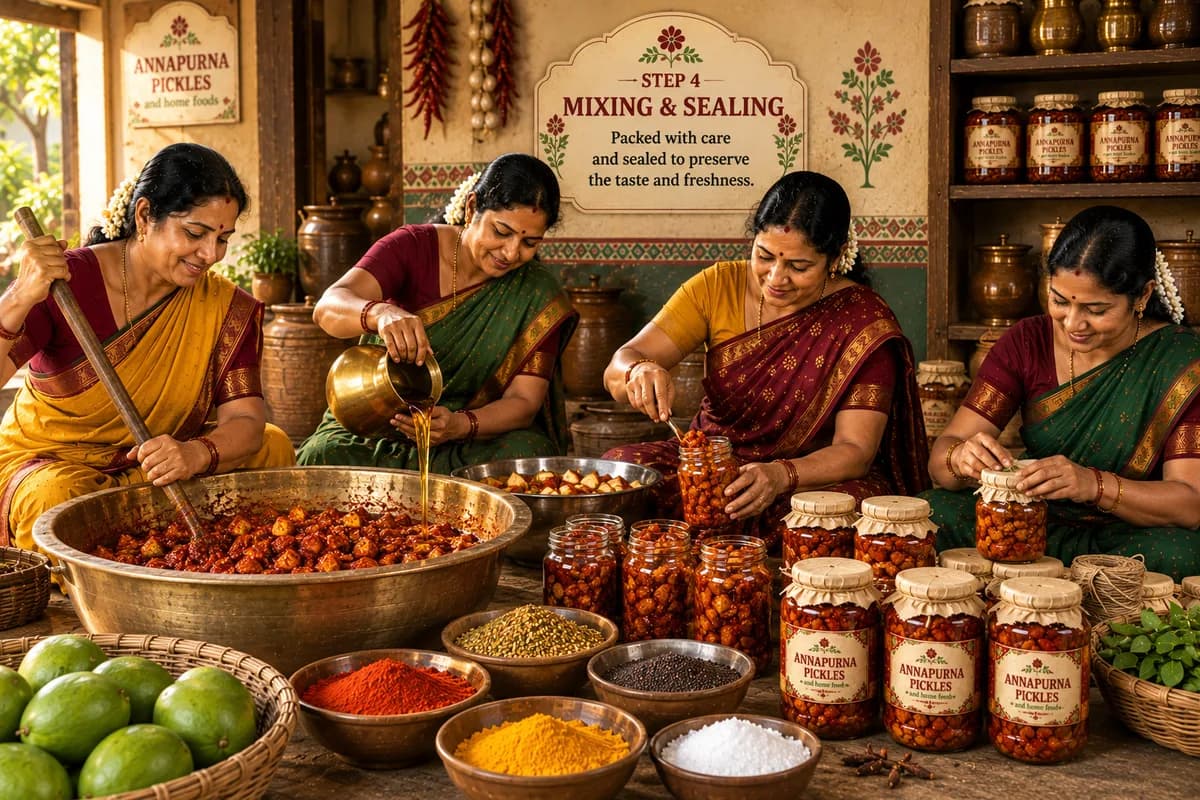
4Sealed with cloth and string, then left alone
Cotton over the mouth, jute around the neck, and three days in the shade before it is touched. The oil has to find its way down through the pieces on its own.
 5
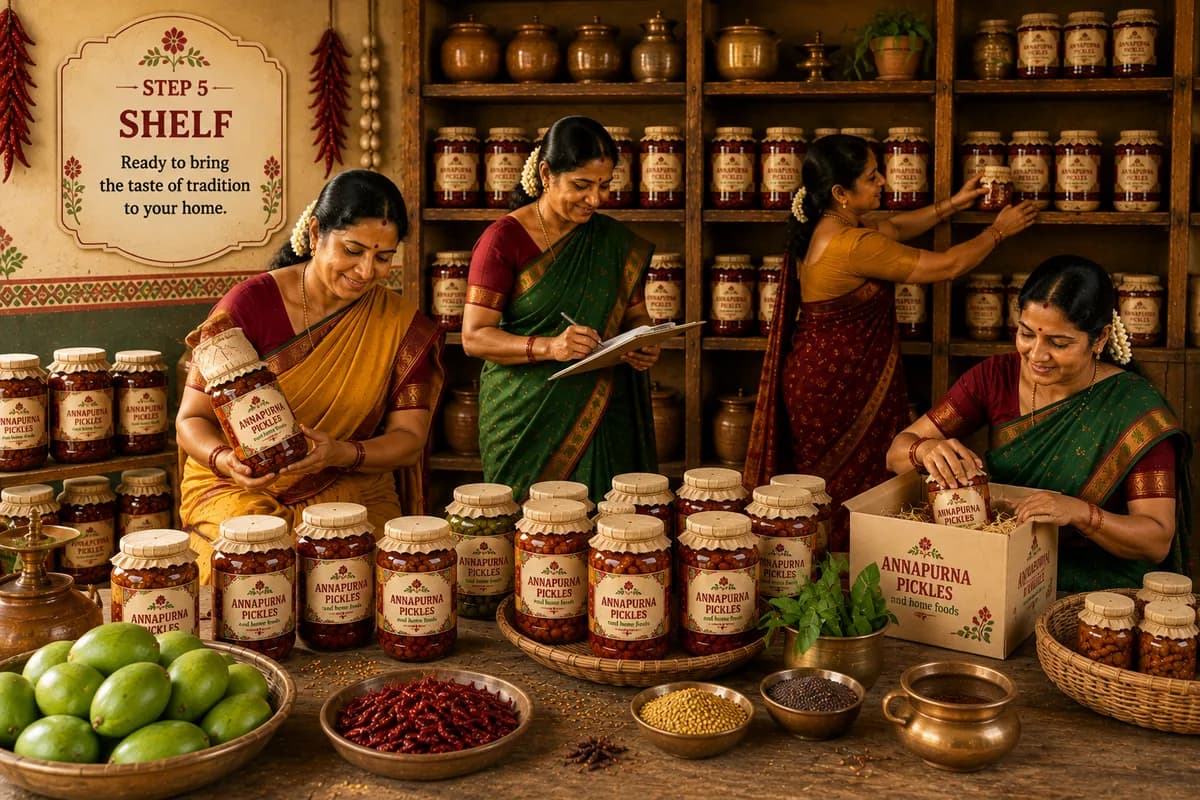
5Labelled by hand, one shelf at a time
Batch and date written on every jar. If a batch is not right it does not get a label — it goes back to the house, and there is no avakaya that fortnight.
1999–2012
Awards & recognitionగుర్తింపులు
Prizes at Department of Horticulture shows, and rural-producer exhibitions organised by state and central government. These are the entries as the certificates record them.
- 2012Exhibition
SARAS Exhibition 2012
Exhibitor · Self-help group and rural products
Ministry of Rural Development, Government of India, and Department of Rural Development, Government of Andhra Pradesh
Nampally Exhibition Grounds, Hyderabad · 19–30 October 2012
- 2011Exhibition
Regional SARAS 2011
Exhibitor · Rural and self-help group products
Ministry of Rural Development, Government of India, and Rural Development Department, Government of Jammu & Kashmir
Kashmir Haat, Srinagar · 15–27 July 2011
- 2010Exhibition
SARAS Mela, India International Trade Fair
National exhibitor · Self-help group and rural products
Ministry of Rural Development, Government of India / CAPART
Pragati Maidan, New Delhi · 14–27 November 2010
- 2010Exhibition
Regional SARAS 2010
Exhibitor · Self-help group and rural products
Department of Rural Development, Government of Andhra Pradesh
People’s Plaza, Necklace Road, Hyderabad · 4–17 October 2010
- 2010Exhibition
Regional SARAS 2009–10
Exhibitor · Rural and self-help group products
Ministry of Rural Development, Government of India, and Department of Rural Development, Government of Andhra Pradesh
People’s Plaza, Necklace Road, Hyderabad · 8–16 February 2010
- 2010Training
PMEGP Entrepreneurship Development Programme
Completed EDP training · Enterprise development
Ministry of MSME, Andhra Pradesh Productivity Council and the District Industries Centre
Vijayawada · 8–19 February 2010
- 2009Prize
Mango Show 2009
Third Prize · Homemade products — pickle
Department of Horticulture, Government of Andhra Pradesh
26–28 May 2009
- 2002Prize
12th AP Horticulture Show
Second Prize · Homemade products — vegetable pickle
Department of Horticulture, Government of Andhra Pradesh
26–28 January 2002
- 2001Prize
Mango Show 2001
First Prize · Pickle
Department of Horticulture, Government of Andhra Pradesh
Tirupati, Chittoor District · 26–28 May 2001
- 2001Recognition
Krishna Mahotsav 2001
Recognition · Self-help group and rural products
Krishna District
February 2001
Handwritten on the certificate and not fully legible — recorded as read.
- 2001Prize
11th Horticulture Show
First Prize · Garlic pickle
Department of Horticulture, Government of Andhra Pradesh
26–28 January 2001
- 2001Prize
11th Horticulture Show
Second Prize · Cabbage pickle
Department of Horticulture, Government of Andhra Pradesh
26–28 January 2001
- 2000Exhibition
SARAS Pavilion, India International Trade Fair
National exhibitor · Products made by rural producers
Ministry of Rural Development, Government of India / CAPART
New Delhi · 14–27 November 2000
- 2000Prize
10th Horticulture Show
First Prize · Pickles — homemade products
Department of Horticulture, Government of Andhra Pradesh
26–28 January 2000
- 2000Prize
10th Horticulture Show
Second Prize · Pickles — homemade products
Department of Horticulture, Government of Andhra Pradesh
26–28 January 2000
- 1999Exhibition
Southern Regional Exhibition of Rural Products
Exhibitor
Government of India, organised by Government of Tamil Nadu
Chennai · 22–24 October 1999
- 1999Recognition
Certificate of Distinction
Certificate of Distinction · Work relating to rural and women’s development
Collector & District Magistrate, Krishna District
Machilipatnam · 15 August 1999
Handwritten on the certificate and not fully legible — recorded as read.
- 1999Prize
9th Horticulture Show
Third Prize · Homemade products — pickles
Department of Horticulture, Government of Andhra Pradesh
26–28 January 1999
A prize at a government-organised show recognises the entry, not the business. We do not describe ourselves as government certified or approved, because these certificates do not say that — and what they do say is good enough.
What we will not do
We do not buy in and re-label.
Every jar is cooked here. If we are out of something, we say we are out of it.
We do not cut the salt or the oil.
They are what makes a pickle keep for a year without a preservative. A low-oil pickle needs a chemical in it, and we would rather not.
We do not mix veg and non-veg.
Separate vessels, separate area, separate storage, separate carton. No exceptions, ever.
We do not make what is not in season.
Avakaya is a summer job. If the mangoes are not right that fortnight, there is no avakaya that year.